
Evergreen plants have been considered to be potent symbols of growth and re-birth particularly in Europe and Western Asia for thousands of years, they are especially welcome in the barren winter months in time for Christmas.
Christmas Celebration Plant Lore
The Holly and the Ivy, Mistletoe, Christmas Trees, Yule Log
Evergreen plants were originally used in winter festivities as a means of ensuring that life and growth would return again in the spring, these days they provide a bright and welcome reminder of the warmer, greener and more fruitful days to come in the middle of the bleak midwinter.
The plants that we now bring into our homes to celebrate Christmas time are almost without exception, taken from pagan midwinter feasts of Northern Europe rather than from Christian origins and pre-date modern religious significance which has been overlaid onto the older traditions. One of the main differences is that we now bring such greenery into our homes much sooner than used to be done. It shouldn't be brought into the house until Christmas Eve as this was considered bad luck. Although these days Christmas is just far too exciting an event for most people who celebrate it to wait - particularly if you have children!
Holly, Ilex
The holly and the ivy,
Now
both are full well grown.
Of all the trees that are in the
wood,
The holly bears the crown
Traditional
Christmas Carol (1st verse)
 Like other evergreens, holly has represented immortality ever
since people began to look to plants for inspiration, it has
been regarded as a plant of good omen since Early Times
(It is now widely accepted by scholars that "Early Times" lies
between the Late Eocene and "Donkeys Years Ago").
Like other evergreens, holly has represented immortality ever
since people began to look to plants for inspiration, it has
been regarded as a plant of good omen since Early Times
(It is now widely accepted by scholars that "Early Times" lies
between the Late Eocene and "Donkeys Years Ago").
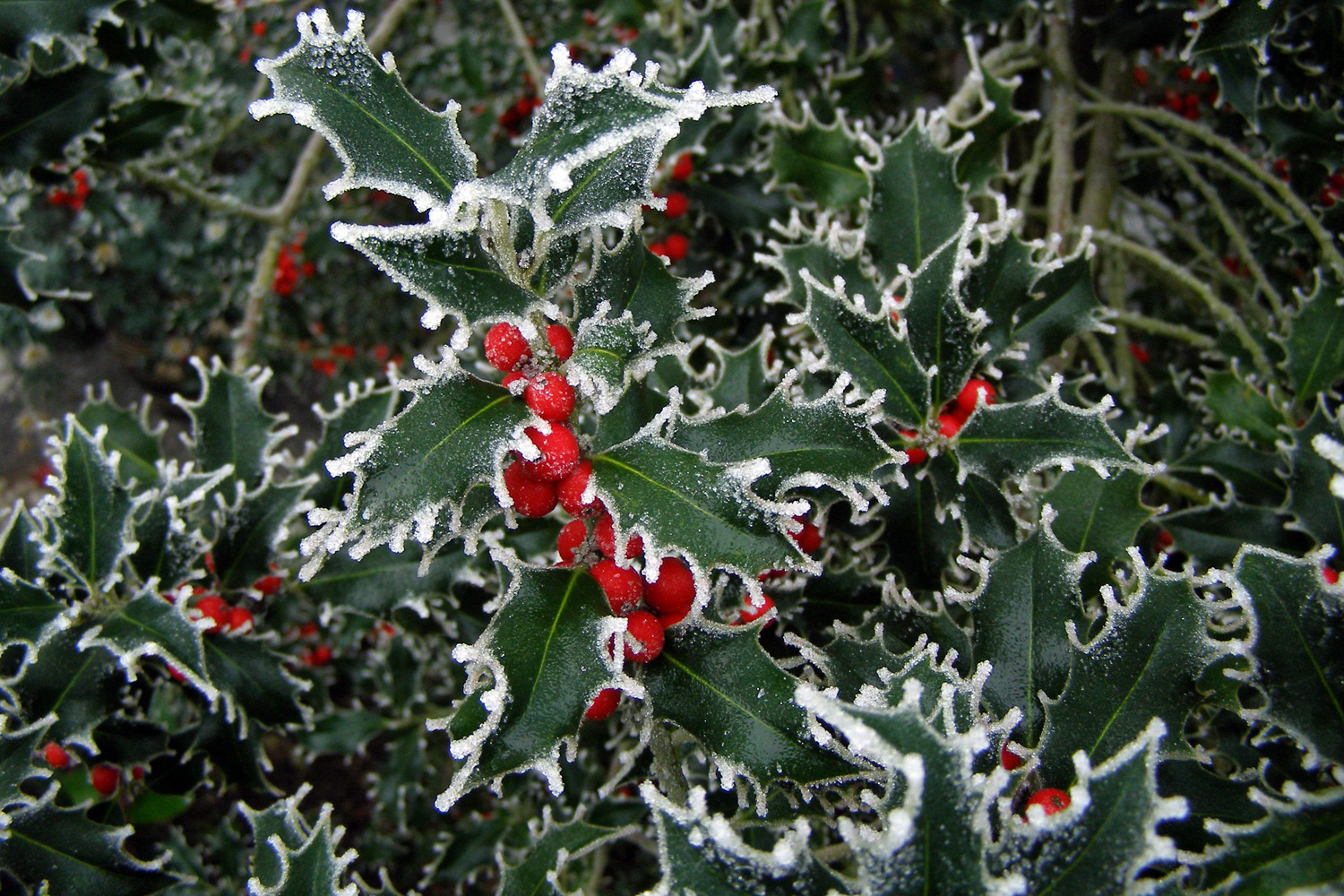
Holly has the advantageous property of looking as good in mid-winter
as in mid-summer, other evergreens can look a bit poorly
in the winter even though they perk up again when spring arrives
- this amongst other things probably has helped its position
in folk-lore.
All evergreens shed their leaves through the year, they just don't do it all in one go like deciduous plants. Holly tends to do this mainly in the spring, again helping it look good through the winter.
Holly was taken into homes when winter began to shelter the
elves and fairies who could live with mortals at this
time without causing injury (maybe they get trodden on at other
times?). Holly was regarded as an excellent form of protection
for all manner of things but specifically against evil spirits,
poisons, thunder and lightning and the evil eye.
There are records of gifts of holly being given at the Roman
festival of Saturnalia which lasted 5 days and ended with the
winter solstice. Early Christians began to use holly in Nativity
celebrations to disguise their Christianity, as it was sacred
to pagan gods it gave the impression that they were taking part
in Saturnalia.
Holly along with mistletoe was banned by the early Christian
church due to its connections with pagans. This ban
wasn't lifted until the 1600's, by then legends had been made
up about holly and the crucifixion (clearly not by botanists)
to fit something that was a jolly useful winter decoration.
One such erstwhile tale claims that holly sprang up under Christ's
feet as he walked to Calgary, the red berries representing his
blood. Another is that the crown of thorns was made of
holly and the berries which were originally white were stained
red with blood when the spikes broke the Christ's skin. There
are even claims that holly wood was used to make the cross.
More recently the "Holly King" a tradition carried on in mummers
plays would vie with the "Oak King" for the hand of
a fair maiden. At midsummer the oak king was defeated by the
holly king, at midwinter, the oak king was victorious and so
the seasonal tides flowed smoothly.
 In some parts of Ireland, the holly from Christmas was kept
and burned to help cook the pancakes on Shrove Tuesday.
In some parts of Ireland, the holly from Christmas was kept
and burned to help cook the pancakes on Shrove Tuesday.
In rural areas of England, a bunch of holly was placed in the
stable or cow shed on Christmas Eve to bring luck and favour
the animals.
A European tradition says that whoever brought the first holly
into the house, husband or wife, at Christmas would rule the
house for the next year. Likewise prickly holly is
said to be male while smooth leafed holly is said to be female,
and which sort is brought in will affect whether the man or
woman of the house will hold sway.
Bringing holly into the house before Christmas Eve will lead
to family quarrels, though as the tree symbolizes peace
and joy, disputes and differences of opinion can be settled
under a holly tree.
Holly is also claimed to have many healing powers when used
as a herb. It has been used for asthma, rheumatism,
gout and dropsy. It was administered as holly tea in parts of
central Europe, India and by Native Americans who would use
it as a cure for measles.
Holly berries can be eaten by wildlife such as birds, but are
poisonous to humans causing vomiting.
Things to avoid with holly which bring bad luck:
- burn it while still green
- smash the berries
- bring holly flowers into the house in the summer
A sprig of holly on the bedpost however is thought to bring
happy dreams and holly decorations throughout the house bring
a pleasant and jubilant atmosphere.
Holly varieties and cultivation
Heigh-ho! sing, heigh-ho! unto
the green holly
Most friendship is feigning, most loving
mere folly.
Then heigh-ho! the holly!
This life is most
jolly.
Shakespeare - As You Like It